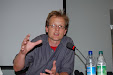
Samir Amin is regularly put together with three
other progressive, left academic intellectuals, Immanuel Wallerstein, Andre
Gunder Frank and Giovanni Arrighi. And indeed, he collaborated closely with
them especially during the 1970s, when they were known within academia as the
‘Gang of Four’. Nevertheless, his book Global History: A View from the South (Pambazuka Press, 2011) makes clear that
Samir Amin has adopted independent positions on a number of key issues, which
differentiate him from the others and provide the basis for an important
criticism of Eurocentrism.
Thursday, 24 May 2012

Friday, 18 May 2012
Globalisation, labour and the manufacturing of insecurity
The book ‘Grounding Globalization: Labour in the Age of Insecurity’ by Eddie Webster, Rob Lambert and Andries Bezuidenhout is an excellent engagement with labour’s current role in the global economy. It not only outlines well the challenges faced by trade unions in view of neo-liberal globalisation, it also explores new ways of resistance.
Thursday, 10 May 2012
The historical challenge of the Greek Left!
‘The
Greek Left is facing an enormous historic challenge’, writes Panagiotis Sotiris.
‘Two years of intense struggle and bitter austerity measures have led many
people to ask for a radical alternative. This cannot be simply a “progressive
government” that will attempt to avoid austerity while remaining within the
embedded neoliberalism of the Eurozone and the systemic violence of debt. It
must be an attempt towards forming a new “historical bloc”, a broad social and
political alliance around an anti-capitalist program of radical social change’
(The Press Project).
Monday, 30 April 2012
Resisting Financial Dictatorship - Reclaiming Democracy and Social Rights!
'The European Commission and the Council use the shock of the "sovereign debt crisis" to redraw the European economy, following a radical monetarist and neo-liberal vision, promoted by the ECB', declared around 30 organisations at the Second Joint Social Conference in Brussels on 29 and 30 March 2012.
Friday, 27 April 2012
Success of the Left in Greek elections?
'At this moment the opinion polls show the combined vote to the left of Pasok approaching 40 percent' states Panos Garganas, editor of the Greek newspaper Workers Solidarity in an interview with the journal International Socialism.
In this wide-ranging interview on the forthcoming Greek elections on 6 May, Garganas describes the people's sufferings as a result of imposed austerity programmes and the increasing resistance to these programmes, he deals with the dangers of a shift to right-wing extremist parties, as well as assesses the chances of the progressive left. Solidarity strike action in other countries as well as the debate of an anti-capitalist programme are the key challenges in his eyes.
Thursday, 29 March 2012
‘For a Public University’ – the need for conceptual alternatives.
The current onslaught on Higher Education in the UK is unprecedented. The cut of state funding, the increase in tuition fees of up to £9000 per year, the attack on the pension systems of staff members, all these factors contribute to the danger of an increasing marketization of Higher Education. In order to resist restructuring, it is not enough to fight individual aspects of the programme. Comprehensive alternative visions of how Higher Education could be run differently also need to be developed. Together with others, the Local University and College Union (UCU) Association will hold the workshop ‘For a Public University’ at the University of Nottingham on 15 June 2012 in order to contribute to the development of such visions.
Thursday, 22 March 2012
German workers and the Eurozone crisis!
Germany is widely considered to be the dominant economic power in Europe. It is Angela Merkel, the German Chancellor, who determines which measures should be adopted in response to the sovereign debt crisis of the Eurozone. On the back of a booming German export industry, German workers are often deemed to be part of the winners in the current financial and economic crisis. As the recent report Explodierender Reichtum, wachsende Armut (Exploding Wealth, Increasing Poverty) by the German Confederation of Trade Unions (Deutscher Gewerkschaftsbund, DGB), however, makes clear, such a conclusion overlooks these workers’ concrete position within the German economy, their falling share in wealth as well as the general increase in inequality in German society.
Subscribe to:
Posts (Atom)

 Posts
Posts