The purpose of this blog is to provide analytical commentary on formal and informal labour organisations and their attempts to resist ever more brutal forms of exploitation in today’s neo-liberal, global capitalism.

Thursday, 5 January 2023

Global Capitalism, Global War, Global Crisis - new book review

Just over four years ago, Adam D. Morton and I published our book Global Capitalism, Global War, Global Crisis (CUP, 2018). In this book, we assess the forces of social struggle shaping the past and present of the global political economy from the perspective of historical materialism. We unravel the internal relations between global capitalism, global war and global crisis, an endeavour which has become even more important now considering ongoing capitalist crisis and the heightened geo-political conflict reflected in the war in Ukraine. 

In this guest post, Pedro Nunes reflects on some of the key contributions of this book as well as further necessary work beyond it.  

Friday, 16 December 2022

COP 27 – Surviving the Apocalypse: From ‘me’ to ‘we’.

Ultimately, it comes down to political will, when confronting the climate crisis. Instead of indulging in Elon Musk’s fantasies about life on Mars, we need to focus on solutions in the here and now on earth, argued Alan Simpson in his final TED talk on how to confront the climate crisis. What is required is a visionary space for nature and the necessary political will to enact it. Money is not the issue.


Monday, 12 December 2022

COP 27 – Greening Everything: Putting back more than we take out.

If we want to confront the climate crisis successfully, greening everything and here especially our cities is key, argued Alan Simpson in the fifth talk of his COP 27 series. Rather than paving over everything in our cities, which is often the cause of flooding, we need to enlarge our green spaces. 

Thursday, 8 December 2022

Watch out Benjamin Zephaniah! International Relations Theory poetry.


With a view to engaging students through different teaching methods, Andreas Bieler and Adam David Morton launched a poetry competition in 2011 on their core MA module "Theories and Concepts in International Relations". After all, Roland Bleiker has himself emphasised the role of the poetic image in challenging dominant modes of thinking and practice within International Relations. With that aim in mind and the permission by the author, I am happy to publish this winning poem by Zubeda Mir that may surely rival the social criticism of Benjamin Zephaniah!

Tuesday, 6 December 2022

COP 27 – ‘The 15-minute city’: connectivity as driver of carbon reduction.

We do have the necessary alternatives. What is missing are politicians with the necessary radical vision to put these alternatives into practice, declared Alan Simpson at the opening of his fourth talk on how to confront the climate crisis. At the heart of this talk was the question of how can we rethink transport and mobility to overcome our addiction to cars? Ultimately, improved local transport combined in a joined-up system with local energy generation and food production is the way forward.

Tuesday, 29 November 2022

COP 27 – Energy: Back to the Future, local democracy, public ownership and social inclusion.

In his third talk on the Climate Crisis, Alan Simpson tackled the issue of energy production and distribution in a shift away from fossil fuel and towards green energy. Importantly, this is not simply a technological question of new inventions. This is about how to organize socially the production and distribution of energy differently, challenging directly the private ownership of the big energy companies.


Tuesday, 22 November 2022

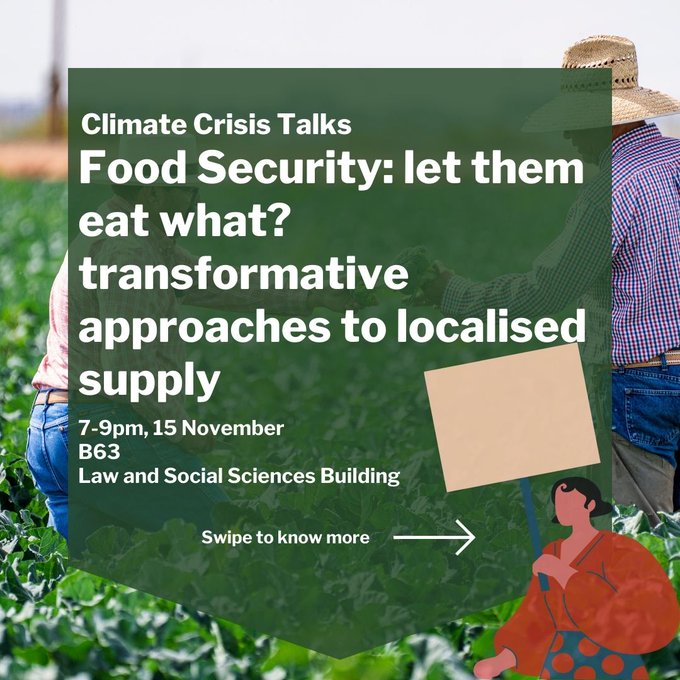
COP 27 – Feeding the Future

In his second talk on the Climate Crisis, Alan Simpson focused on how to ensure sufficient, sustainable production of food for the future. The global food production system, based on ‘free’ trade and tightly controlled by a few large transnational corporations, results in one-third of what we produce being wasted. At the same time, offloading our surpluses in developing countries destroys the local food production there. In short, the problem is not growing enough food, the problem is how to ensure that food is produced sustainably and locally reaching everybody.