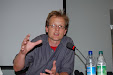
While London is one of the most glamorous and
expensive cities in the world, the workers who keep the British capital clean
are often overlooked and disregarded. They are paid so lowly that they can often
barely survive. And yet, cleaners are fighting back. In a seminar organised by
the Centre for the Study of
Social and Global Justice (CSSGJ) at Nottingham University, Albero, Percy
and Petros from the independent union United Voices of the
World reported from their successful struggles to ensure the payment of
the living wage at the Barbican as well as Sotheby's Auction house in London.
In this post, I will report on some of the key aspects of their struggles.
Friday, 13 March 2015
Wednesday, 18 February 2015
The End of Cheap Labour in China?
China’s developmental strategy has been
based on cheap labour, foreign direct investment (FDI) and the assembling of
pre-fabricated parts for export to North American and European markets. This
export-oriented growth strategy in low value added production sectors has,
however, come under pressure as a result of the global economic crisis and a
decline in global demand. In his presentation at Nottingham University on 17
February, jointly hosted by the School of Contemporary
Chinese Studies and the Centre for the Study of
Social and Global Justice, Florian Butollo from Jena University in Germany
investigated whether China’s attempts at industrial upgrading in response to
the crisis have also resulted in ‘social upgrading’ for its workforce.
Monday, 2 February 2015
The Great Pension Robbery – UCU unravelling!
Only three years after closing the final salary pension scheme of USS for new members of staff in pre-1992 Higher Education (HE) institutions in the UK, the employers returned to the table with new demands. This time they asked for cuts to staff members’ pensions of around 27 per cent. Initially, the University and College Union (UCU) responded forcefully and carried out a ballot for industrial action: 78% of union members who participated voted for strike action and 87% voted for action short of a strike. The turnout of 45% was the highest in a national higher education ballot since UCU was formed in 2006. And yet, in January 2015 UCU settled for a negotiated deal, which was only marginally better for members than the initial proposals by the employers. Instead of 27 per cent of cuts, many members will now face cuts of somewhere between 20 and 24 per cent. How could this happen? In this blog post, I will provide a critical assessment of this struggle, drawing also on my own experience as a member of the Higher Education Committee (HEC), where the crucial decisions were taken within UCU.
Friday, 23 January 2015
Greece at the ballot box – How should the European left show solidarity?
On Sunday, 25 January the Greek people
are voting for a new parliament. According to opinion polls, this time the left
party Syriza may win the elections (BBC, 22 January 2015).
In view of the heavy pressure put on Greece by financial markets, the European
Commission as well as European Central Bank, people of the European left are
calling for solidarity. Support is needed especially should Syriza form the
next government and demand from the European Union (EU) a re-negotiation of the
terms of its bailout package. In this blog post, I will reflect on what form
these solidarity actions may take.
Tuesday, 6 January 2015
Chinese labour in the global economy – What do we know?
From October 2011 to
September 2014, we worked on the project Chinese
labour in the global economy, supported by an ESRC research grant (RES-062-23-2777,
£275k). Throughout this period, Chun-Yi Lee carried out a number of field
research trips to China in order to interview workers, labour academics and
representatives of informal labour NGOs. We organised a related panel at the
World Congress of the International Sociological Association in Yokohama/Japan
in July 2014 and held an international
workshop at Nottingham University in September 2014. In this post, we
provide an overview of the main findings of the project.
Tuesday, 23 December 2014
We make our own history – A call to action!
‘As we become political subjects on our
own behalf, recognise ourselves in each other and see the connections between
our different movements, we come closer to being able not only to articulate
the hope of “another world”, but also to bring it about’ (P.209). With these
words, Laurence Cox and Alf Gunvald Nilsen conclude their latest book We make our own history: Marxism and Social
Movements in the Twilight of Neoliberalism (Pluto Press, 2014). In this
blog post, I will provide a critical appraisal of this important book.
Monday, 15 December 2014
Belgium’s “hot autumn”: opportunities and challenges.
Subscribe to:
Posts (Atom)